When Crypto Faith Becomes the 'Plato's Cave' in Modern Investing

比推2025-12-12 tarihinde yayınlandı2025-12-12 tarihinde güncellendi

Özet

In "When Crypto Belief Becomes a Modern 'Plato's Cave'," the author reflects on how initial optimism in cryptocurrency has evolved into a "sunk cost trap," where past investments—whether financial, temporal, or emotional—keep individuals tethered to an ecosystem that may no longer serve their best interests. Drawing parallels to Plato’s allegory of the cave, the piece argues that many in crypto remain chained not by ignorance but by their accumulated stakes, mistaking shadows (past efforts) for reality. The author shares a personal journey from professional poker to crypto, illustrating how sunk costs—like a decade in poker—can create a "luxurious trap" that’s hard to escape. Despite crypto’s maturation (e.g., Bitcoin and Ethereum ETFs, Robinhood adopting blockchain tech), the landscape has shifted: traditional finance co-opts crypto innovations, and gains increasingly flow to insiders or equities rather than retail token holders. The article categorizes crypto adherents into four camps (pro-Bitcoin, pro-crypto, both, or neither) and further divides them based on belief in future upside. It suggests that only those fully convinced of crypto’s potential should devote all their time to it; others should diversify skills and consider exit strategies. The core message: don’t let sunk costs imprison you in a fading dream. Freedom lies in acknowledging when to step away and explore broader opportunities beyond the crypto.

Author: Evanss6

Compiled by: AididiaoJP, Foresight News

Original Title: When Faith Becomes a Cage: The Sunk Cost Trap in the Crypto Era


At any point in the past, this might have been good advice when talking about cryptocurrency: hoard Bitcoin, or maybe mainstream coins, do some staking, try new products with rewards, and don't get liquidated playing with contracts—chances are you would have made money. Behind this are two core beliefs: Bitcoin will become a more mainstream non-sovereign store of value, and smart contracts will become the infrastructure of finance.
I won't go into detail about how these judgments have been validated, because we need to talk about this "cage." Just two facts:

Bitcoin ETFs have seen $49 billion in inflows, Ethereum ETFs have seen $4.3 billion, and more altcoin ETFs are just getting started. Michael Saylor himself has purchased over $40 billion, and many companies are gradually buying in.

Robinhood just announced it will use Arbitrum's tech stack to build an EVM chain as the backend financial infrastructure for its platform, and will also list the most popular product in cryptocurrency: perpetual contracts.

Cryptocurrency is increasingly resembling traditional finance. It's being bought by the previous generation in brokerage accounts, promoted by Larry Fink, and used by companies like Robinhood with technology. What many of us imagined a decade ago is coming true.

So what exactly is the "sunk cost cage"?

Simply put, it's persisting with something because of past investments. This can appear in many places: your skills, investments you still hold, your relationships, a job you're afraid to quit, or spending all your time on cryptocurrency.

  • "I don't want to leave her because our past is too deep."

  • "I don't want to change careers because I've spent too much time on this."

  • "I don't want to sell my Ethereum because I bought it early, and it's been good to me."

These are all sunk cost fallacies. Not realizing you're thinking this way is a form of self-sabotage, keeping you doing things you know deep down are no longer beneficial.

The sunk cost cage is the modern version of Plato's Allegory of the Cave.
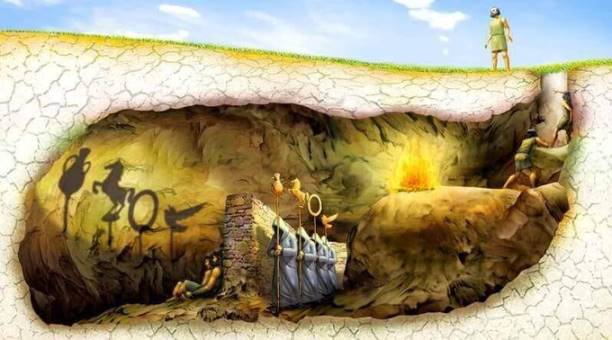
The prisoners only know the shadows on the wall, unaware of where the shadows come from or that there's a larger world outside.

In Plato's allegory, the prisoners stayed in the cave because they mistook the shadows for reality, unaware of a "more real" world outside. In the modern version, we stay not out of ignorance, but because we've invested too much in the shadows. That job that no longer fits, the career you no longer believe in, the identity built on long hours and silent endurance—these are the costs paid. The more time, education, and reputation invested, the harder it is to leave. The illusion is no longer just external; it's internalized as duty, logic, and the "reasonable thing to do."

But freedom isn't cheap. Escaping the sunk cost cage means admitting that what you've built might no longer serve you. Past efforts cannot be the reason to continue staying. Like the prisoner turning towards the light, this requires not only courage but also betraying the part of yourself that is overly loyal to your own investments. The hardest part isn't seeing the truth, but saying goodbye to the self that stayed too long, believed too deeply, and paid the price for the cage.

My Experience

I stayed in a cage for a long time myself.

I fell in love with poker in my teens. In the back row of high school classes, I was always calculating bankroll expectations in a notebook, not listening to lectures or taking notes. Within two years, I went from $0.01/$0.02 micro-stakes to high-stakes tables. Over time, I liked playing less and less, seeing it only as a way to make money, always thinking "I'll quit in another two or three years."

But a decade passed, and nothing changed. I was still playing, still winning, but always felt the money wasn't enough to "do something else." Worse, I didn't even know what else I could do, and I saw clearly: poker was a declining game, and I had to work harder and harder just to keep up. But I told myself I should continue because I had spent so much time getting good, it offered better returns than other options, I had no other viable path, and no time to think—staying a consistent winner in high-stakes online games was exhausting enough: studying strategy, finding good games, avoiding cheats and shady sites...

To be honest, this "can't easily switch careers because it makes money" is a luxurious problem. But as it became harder to find a better industry, I knew the days were numbered.

First Encounter with Cryptocurrency

I encountered cryptocurrency early through my previous career. In 2012, I first read about Bitcoin on a poker forum called TwoPlusTwo. By then, the Bitcoin subforum had been open for over a year.

The first reply was hilarious: "This thing is worth 70 cents now? A currency no one uses can reach this price, lol." The second reply said you could actually exchange it for dollars or buy pizza—these were the early uses of what later became a $2 trillion asset. Scrolling down a few more posts:
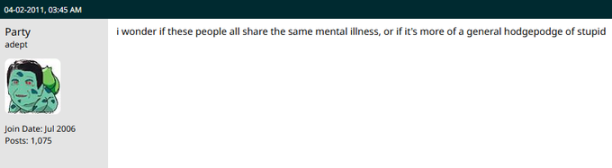
"Really missed an era." Anyway, I noticed it because some poker sites started using it. At the time, I thought its $2 billion market cap was outrageous. If it was only for black/gray markets, maybe it was worth that; if it could go mainstream, its value would multiply endlessly.

By 2016-17, as my investments became substantial, I spent more and more time on cryptocurrency (especially ICOs). This diversion of time was my first step out of the cage. But it wasn't until the rise of DeFi in 2020, when you could actually make money, that I fully jumped in.

Back then, I knew nothing about trading and had to learn by doing. I studied economics and math in college, but my real skill was poker. Fortunately, poker is excellent training for trading: it gives you ruthless real-time feedback on decisions, forces you to manage risk, price correctly, develop overall strategy, and builds emotional resilience and soft skills to withstand bad runs—all necessary for independent trading.

In the end, I'm grateful and lucky to have spent a lot of time from 2013-2019 exploring these curiosities, which put me in the best position when the opportunity arose. If I had focused more on poker those years, I might have played better, but following my intuition to formulate a transition/exit plan was truly fortunate.

How does this "cage" apply today?

In recent years, financial nihilism has become increasingly apparent in the crypto circle. More and more people no longer believe in the beautiful ideals they held when they first entered. The goal has become "making money," going all in, working desperately, and "exiting" when you've made enough.
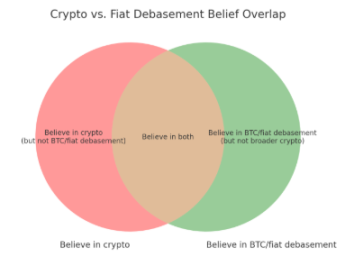
Roughly, there are four camps:

  • Green Camp (Believe in Bitcoin, don't believe in other cryptocurrencies)

  • Red Camp (Believe in cryptocurrency, don't believe in Bitcoin)

  • Brown Camp (Believe in both)

  • White Camp (Believe in neither)

Add two scenarios to each camp, and it becomes eight types:

  • (a) Believe there is still upside potential, worth the risk

  • (b) Believe the upside has already been taken by early buyers

I believe only those in 2(a) should devote all their time to cryptocurrency. If you are in 1(b), 2(b), 3(b), or 4(b), you'd better start diversifying your time and making an exit plan. If you are in 1(a) or 4(a), just hold Bitcoin and don't pay too much attention to anything else. 3(a) can hold some Bitcoin and other assets, splitting time and energy between crypto and non-crypto. If you've seen my account and posts, you can probably tell that I, who was mostly in 2(a) from 2015-2023, am now somewhat wavering between 1(a), 3(a), and 3(b).

Let's talk about the Red Camp. It's been quite painful staying here the past few years.

We've basically been in a situation of continuously rising Bitcoin dominance, even though the overall cryptocurrency system is more widespread. Even if you accurately predicted that the Ethereum ETF would see over $4 billion in net inflows, predicted that giants like Robinhood would use its technology, predicted that Trump would win, reform the SEC, end OCP2.0, and create a pro-crypto environment. From the day the ETF launched, your Ethereum investment is still down. And today Ethereum is around $2600, investors from 2015 are up 2000 to 8600 times.

So the answer

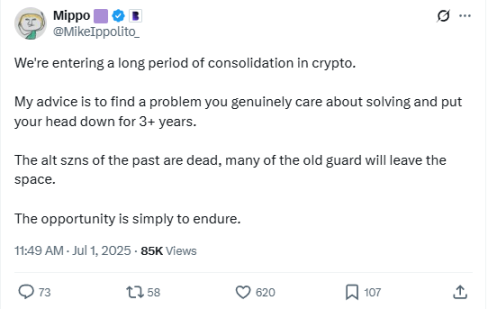
I doubt whether "perseverance," as Mippo said in the tweet at the beginning of this article, is really the right path, the biggest opportunity. Everything you dreamed of has either already happened or is on its way. In 2017, if Robinhood announced developing on Ethereum, the price would have jumped 10% immediately, but now it's different. The move now is to buy HOOD stock. I believe there are still opportunities in cryptocurrency, but the trend of opportunities being taken by non-crypto assets (stocks) or insiders (teams/private investors, look at Celestia Finance) is not friendly to dreamers. If you really want to "persevere," you have to invest in these projects early or build them yourself. So Mippo isn't wrong, solving real problems in crypto is still an opportunity. But don't think that just because crypto technology is becoming widespread, current coin prices will necessarily rise (especially compared to other assets you could invest in).

Unless you are a true Red Camp diehard 2(a), "perseverance" is choosing to stay in the cave watching shadows on the wall, while people outside are already working on AI and robotics.

You'd better honestly ask yourself: Which camp are you in? Do you even like cryptocurrency? Regardless, try to cultivate some skills that are also useful elsewhere, so if it doesn't work out, you have a fallback. At the very least, you won't be unhappy from spending all your time on something you're already tired of. And if you're wrong, you have a soft landing place.

The door of the sunk cost cage isn't locked; what traps you is your own thoughts. All you need to do is open the door from time to time and walk out. Life is beautiful, the world is full of possibilities.


Twitter:https://twitter.com/BitpushNewsCN

Bitpush TG Discussion Group:https://t.me/BitPushCommunity

Bitpush TG Subscription: https://t.me/bitpush

Original article link:https://www.bitpush.news/articles/7595320

İlgili Sorular

QWhat is the 'sunk cost cage' as described in the article?

AThe 'sunk cost cage' is the modern equivalent of Plato's allegory of the cave. It refers to the psychological trap where individuals persist in a course of action (e.g., a job, investment, or relationship) because of the significant resources (time, money, effort, identity) they have already invested, even when they know it is no longer beneficial. The 'prisoners' are trapped not by ignorance of a better reality but by their own past investments, which they feel obligated to justify.

QHow does the author relate their personal experience with poker to the sunk cost fallacy?

AThe author played professional poker for over a decade. Despite growing to dislike the game and recognizing it was a declining industry, they continued because of the significant time and effort invested to become skilled. They felt trapped by the belief that they had no other viable career path and that the money earned made it difficult to transition, even though they knew it was no longer the right path. This is a direct example of the sunk cost fallacy.

QAccording to the author, what are the four main camps in the crypto space, and what are the two sub-conditions for each?

AThe four main camps are: 1. Green Camp (believe in Bitcoin, not in crypto), 2. Red Camp (believe in crypto, not in Bitcoin), 3. Brown Camp (believe in both), and 4. White Camp (believe in neither). Each camp is further divided into two sub-conditions: (a) those who believe there is still significant upside potential and it's worth the risk, and (b) those who believe the upside has already been captured by early investors.

QWhat does the author suggest is the risk for those who choose to 'persevere' (HODL) in crypto without being a true believer?

AThe author suggests that for anyone not in the true believer category (specifically Red Camp 2(a)), choosing to 'persevere' or HODL is like choosing to remain in Plato's cave watching shadows on the wall. Meanwhile, the larger world is moving on to other major technological advancements like AI and robotics. The opportunity cost of staying in a cage built on past beliefs, rather than exploring new possibilities, is the primary risk.

QWhat early signs of crypto's mainstream adoption does the author point to as validation of its original promise?

AThe author points to several signs of mainstream adoption: Bitcoin ETFs have attracted $49 billion in inflows, Ethereum ETFs have attracted $4.3 billion, and more altcoin ETFs are starting. Companies like MicroStrategy, led by Michael Saylor, have purchased over $40 billion in Bitcoin. Furthermore, traditional finance platforms like Robinhood are building their backend financial infrastructure on crypto technology (EVM chains like Arbitrum) and offering popular crypto products like perpetual contracts.

İlgili Okumalar

Nvidia's Wednesday Earnings Night: The Battle That Decides the Fate of the AI Bull Market is Here

NVIDIA is set to report its quarterly earnings after the U.S. market closes on Wednesday, May 20. This event is widely seen as a crucial test for the current AI-driven bull market. The semiconductor sector is exhibiting severe technical overbought conditions, with the Philadelphia Semiconductor Index (SOX) trading approximately 60% above its 200-day moving average—the most extreme deviation since the dot-com bubble peak of 1999/2000. Market sentiment is highly concentrated on a few AI-related stocks, raising concerns about overall market breadth. Analysts highlight a key contradiction: while fundamentals for AI and semiconductors remain strong, significant technical pressures are building. Option market activity reflects this tension. Positions are heavily skewed towards bullish calls, yet there is also notable hedging activity through put options on broad indices and sector ETFs, signaling preparation for potential downside volatility. An unusual pattern of rising stock prices alongside rising implied volatility further underscores the market's expectation for a major move. For NVIDIA specifically, the market's primary focus will be on its forward guidance for the next quarter, which is deemed more critical than the immediate earnings results. Despite a recent seven-day rally adding roughly $1.7 trillion in market cap, historical data shows NVIDIA's stock has often declined the day after its past five earnings reports. The outcome of this report is expected to have a significant ripple effect across the broader technology and semiconductor markets, given NVIDIA's pivotal role.

marsbit21 dk önce

Nvidia's Wednesday Earnings Night: The Battle That Decides the Fate of the AI Bull Market is Here

marsbit21 dk önce

Harvard University May Have Lost $150 Million in Cryptocurrency Trading! Has Liquidated Ethereum and Significantly Reduced Bitcoin ETF Positions

Harvard University's endowment fund, managed by Harvard Management Company (HMC), recently disclosed significant reductions in its cryptocurrency holdings. According to its latest 13F filing, HMC sold its entire position in the BlackRock Ethereum Spot ETF (ETHA) and reduced its stake in the BlackRock Bitcoin Spot ETF (IBIT) by 43% in Q1 2026. This marks a sharp reversal from its peak holdings of $443 million in crypto assets just two quarters prior, bringing the current value to approximately $117 million. Analysis suggests these sales likely resulted in substantial losses. Estimates indicate HMC's Bitcoin ETF trades incurred a roughly 28% loss (over $100 million), while its brief Ethereum position fell about 35% (over $30 million), totaling potential losses exceeding $150 million. The timing of HMC's trades—aggressively adding to Bitcoin near its all-time high in late 2025 and buying Ethereum just before a market downturn—has drawn criticism as potential "buying high and selling low." However, the context points to broader pressures. Harvard faced a $113 million operating deficit in FY2025 due to cuts in federal research funding and a significant tax increase on endowment income. With much of its portfolio locked in illiquid private equity and hedge funds, the highly liquid crypto ETFs presented the most straightforward assets to sell for liquidity and risk management. Furthermore, HMC's Bitcoin ETF holding had grown to 20% of its public portfolio by Q3 2025, prompting necessary rebalancing. The move contrasts with other institutions like Mubadala (increasing Bitcoin ETF holdings) and Dartmouth College (maintaining and diversifying crypto exposure). Ultimately, Harvard's actions appear driven by a confluence of fiscal stress, liquidity needs, and portfolio risk control rather than a simple market-timing strategy, highlighting how traditional institutional risk calculus applies even to volatile crypto assets.

marsbit33 dk önce

Harvard University May Have Lost $150 Million in Cryptocurrency Trading! Has Liquidated Ethereum and Significantly Reduced Bitcoin ETF Positions

marsbit33 dk önce

Harvard University May Have Lost $150 Million in Cryptocurrency Trading! Has Liquidated Ethereum and Significantly Reduced Bitcoin ETF Holdings

Harvard University's endowment fund, Harvard Management Company (HMC), significantly reduced its cryptocurrency holdings in Q1 2026, reportedly incurring substantial losses. According to its latest 13F filing, HMC completely sold off its position in the BlackRock Ethereum ETF (ETHA) and cut its BlackRock Bitcoin ETF (IBIT) holdings by 43%, leaving a position worth approximately $117 million. This marks a sharp decline from a peak public crypto allocation of $443 million just two quarters prior. Analysis suggests these trades resulted in estimated losses exceeding $150 million, with Bitcoin positions sold at an average loss of around 28% and Ethereum positions at roughly 35%. The moves have sparked debate on whether HMC engaged in counterproductive "buy high, sell low" behavior. The article contextualizes HMC's crypto journey, beginning with its initial disclosed investment in IBIT and gold ETF GLD in Q2 2025 as an "inflation hedge." Aggressive buying in Q3 2025 made IBIT its largest single public holding at 20% of the portfolio, coinciding with Bitcoin nearing all-time highs. Subsequent trimming began in Q4 2025, with an initial foray into ETHA. Explanations for the recent drastic cuts extend beyond market timing. Harvard faces significant financial pressure, including an annual operating deficit and a major increase in endowment tax rates. With illiquid assets like private equity dominating the portfolio, the highly liquid crypto ETFs became the most practical source for necessary portfolio rebalancing and liquidity. Furthermore, the impending retirement of HMC's CEO adds a layer of reputational risk to holding volatile assets. The article contrasts Harvard's retreat with other institutions, such as Mubadala's continued accumulation of Bitcoin ETFs and Dartmouth's expansion into staking-oriented crypto products. It concludes that HMC's actions reflect a complex interplay of fiscal needs, risk management, and institutional constraints rather than simple speculative trading, highlighting how traditional finance logic applies to crypto within large endowment portfolios.

链捕手39 dk önce

Harvard University May Have Lost $150 Million in Cryptocurrency Trading! Has Liquidated Ethereum and Significantly Reduced Bitcoin ETF Holdings

链捕手39 dk önce

WSJ: Unveiling the Secret Jury That Controls Disputes on Polymarket

Last month, Garrick Wilhelm lost a $567 bet on the Polymarket prediction platform about whether a ceasefire would be reached with Hezbollah. When a truce was announced, some traders argued it counted, but Wilhelm disagreed. The dispute was settled not by Polymarket, but by a decentralized group of UMA token holders who vote on such disagreements. As trading surges, resolving ambiguous outcomes is a growing challenge for prediction markets. Unlike competitors like Kalshi that decide internally, Polymarket outsources dispute resolution to UMA. Its token holders, mostly anonymous and with voting power weighted by holdings, arbitrate cases. Critics argue this system is prone to manipulation, as voters can also bet on the same markets they judge. A Wall Street Journal analysis found that over the past year, at least 60% of active UMA voters had corresponding Polymarket accounts and held positions in disputes they voted on. Voting power is also concentrated among a few large holders. Polymarket says only 0.2% of bets go to UMA and that the system disperses authority. Its founder has acknowledged flaws and promised fixes. UMA's backers deny any proven manipulation, dismissing critics as sore losers. The platform penalizes voters in the minority to incentivize "correct" outcomes. Disputes are rising, covering topics from a streamer's pregnancy announcement to Iran. This model also helps Polymarket argue it's an offshore platform outside U.S. regulation, a shift made after a 2022 settlement with the CFTC. Some losing traders have formed groups to protest, targeting entities like UMA.rocks, which aggregates votes. Its founder says traders often blame UMA for their own mistakes. A recently ousted committee member, Scout, admitted to both betting and voting but argued involved voters research more thoroughly. He highlighted the dilemma: "Either you have conflicted traders deciding, or you have uninformed outsiders voting. There is no perfect answer right now."

marsbit1 saat önce

WSJ: Unveiling the Secret Jury That Controls Disputes on Polymarket

marsbit1 saat önce

İşlemler

Spot
Futures

Popüler Makaleler

$S$ Nedir

SPERO'yu Anlamak: Kapsamlı Bir Genel Bakış SPERO'ya Giriş İnovasyonun manzarası gelişmeye devam ederken, web3 teknolojilerinin ve kripto para projelerinin ortaya çıkışı dijital geleceği şekillendirmede önemli bir rol oynamaktadır. Bu dinamik alanda dikkat çeken projelerden biri SPERO, $$s$$ olarak adlandırılmaktadır. Bu makale, SPERO hakkında ayrıntılı bilgi toplamak ve sunmak amacıyla, meraklılar ve yatırımcıların web3 ve kripto alanlarındaki temellerini, hedeflerini ve yeniliklerini anlamalarına yardımcı olmayı amaçlamaktadır. SPERO,$$s$$ Nedir? SPERO,$$s$$, kripto alanında merkeziyetsizlik ve blok zinciri teknolojisi ilkelerini kullanarak etkileşimi, faydayı ve finansal kapsayıcılığı teşvik eden bir ekosistem yaratmayı amaçlayan benzersiz bir projedir. Proje, kullanıcıların yenilikçi finansal çözümler ve hizmetler sunarak eşler arası etkileşimleri yeni yollarla kolaylaştırmayı hedeflemektedir. SPERO,$$s$$'nin temel amacı, bireyleri güçlendirmek ve kripto para alanındaki kullanıcı deneyimini artıran araçlar ve platformlar sağlamaktır. Bu, daha esnek işlem yöntemlerini mümkün kılmayı, topluluk odaklı girişimleri teşvik etmeyi ve merkeziyetsiz uygulamalar (dApp'ler) aracılığıyla finansal fırsatlar yaratmayı içermektedir. SPERO,$$s$$'nin temel vizyonu kapsayıcılık etrafında dönmekte olup, geleneksel finansal sistemlerdeki boşlukları kapatmayı ve blok zinciri teknolojisinin faydalarından yararlanmayı hedeflemektedir. SPERO,$$s$$'nin Yaratıcısı Kimdir? SPERO,$$s$$'nin yaratıcısının kimliği bir miktar belirsizdir, çünkü kurucusu(ları) hakkında ayrıntılı arka plan bilgisi sağlayan sınırlı kamuya açık kaynaklar bulunmaktadır. Bu şeffaflık eksikliği, projenin merkeziyetsizlik taahhüdünden kaynaklanabilir—birçok web3 projesinin paylaştığı bir etik anlayışı, bireysel tanınmanın yerine kolektif katkıları önceliklendirmektedir. Topluluk ve onun kolektif hedefleri etrafında tartışmaları merkezileştirerek, SPERO,$$s$$, belirli bireyleri öne çıkarmadan güçlendirme özünü taşımaktadır. Bu nedenle, SPERO'nun etik anlayışını ve misyonunu anlamak, tek bir yaratıcının kimliğini belirlemekten daha önemlidir. SPERO,$$s$$'nin Yatırımcıları Kimlerdir? SPERO,$$s$$, kripto sektöründe yeniliği teşvik etmeye adanmış girişim sermayedarlarından melek yatırımcılara kadar çeşitli yatırımcılar tarafından desteklenmektedir. Bu yatırımcıların odak noktası genellikle SPERO'nun misyonuyla uyumlu olup, toplumsal teknolojik ilerlemeyi, finansal kapsayıcılığı ve merkeziyetsiz yönetimi vaat eden projeleri önceliklendirmektedir. Bu yatırımcı temelleri, yalnızca yenilikçi ürünler sunan projelere değil, aynı zamanda blok zinciri topluluğuna ve ekosistemlerine olumlu katkılarda bulunan projelere de ilgi duymaktadır. Bu yatırımcıların desteği, SPERO,$$s$$'yi hızla gelişen kripto projeleri alanında dikkate değer bir rakip haline getirmektedir. SPERO,$$s$$ Nasıl Çalışır? SPERO,$$s$$, onu geleneksel kripto para projelerinden ayıran çok yönlü bir çerçeve kullanmaktadır. İşte benzersizliğini ve yeniliğini vurgulayan bazı temel özellikler: Merkeziyetsiz Yönetim: SPERO,$$s$$, kullanıcıların projenin geleceğiyle ilgili karar alma süreçlerine aktif olarak katılmalarını sağlayan merkeziyetsiz yönetim modellerini entegre etmektedir. Bu yaklaşım, topluluk üyeleri arasında sahiplik ve hesap verebilirlik duygusunu teşvik etmektedir. Token Kullanımı: SPERO,$$s$$, ekosistem içinde çeşitli işlevler sunmak üzere tasarlanmış kendi kripto para token'ını kullanmaktadır. Bu token'lar, işlemleri, ödülleri ve platformda sunulan hizmetlerin kolaylaştırılmasını sağlayarak genel etkileşimi ve faydayı artırmaktadır. Katmanlı Mimari: SPERO,$$s$$'nin teknik mimarisi, modülerlik ve ölçeklenebilirliği destekleyerek projenin evrimi sırasında ek özelliklerin ve uygulamaların sorunsuz bir şekilde entegrasyonuna olanak tanımaktadır. Bu uyum sağlama yeteneği, sürekli değişen kripto manzarasında geçerliliği sürdürmek için hayati öneme sahiptir. Topluluk Katılımı: Proje, işbirliği ve geri bildirim teşvik eden mekanizmalar kullanarak topluluk odaklı girişimlere vurgu yapmaktadır. Güçlü bir topluluk oluşturarak, SPERO,$$s$$, kullanıcı ihtiyaçlarını daha iyi karşılayabilir ve piyasa trendlerine uyum sağlayabilir. Kapsayıcılığa Odaklanma: Düşük işlem ücretleri ve kullanıcı dostu arayüzler sunarak, SPERO,$$s$$, daha önce kripto alanında yer almamış bireyler de dahil olmak üzere çeşitli bir kullanıcı tabanını çekmeyi hedeflemektedir. Bu kapsayıcılık taahhüdü, erişilebilirlik yoluyla güçlendirme misyonuyla uyumludur. SPERO,$$s$$ Zaman Çizelgesi Bir projenin tarihini anlamak, gelişim yolculuğu ve kilometre taşları hakkında kritik bilgiler sağlar. Aşağıda, SPERO,$$s$$'nin evriminde önemli olayları haritalayan önerilen bir zaman çizelgesi bulunmaktadır: Kavram Geliştirme ve Fikir Aşaması: SPERO,$$s$$'nin temelini oluşturan ilk fikirler, blok zinciri endüstrisindeki merkeziyetsizlik ve topluluk odaklılık ilkeleriyle yakından uyumlu olarak geliştirildi. Proje Beyaz Kağıdının Yayınlanması: Kavramsal aşamayı takiben, SPERO,$$s$$'nin vizyonunu, hedeflerini ve teknolojik altyapısını ayrıntılı bir şekilde açıklayan kapsamlı bir beyaz kağıt yayımlandı ve topluluk ilgisini ve geri bildirimini toplamak amacıyla sunuldu. Topluluk Oluşturma ve Erken Katılımlar: Projenin hedefleri etrafında tartışmalar yürüterek destek toplamak ve erken benimseyenler ile potansiyel yatırımcılar için bir topluluk oluşturmak amacıyla aktif iletişim çabaları gerçekleştirildi. Token Üretim Etkinliği: SPERO,$$s$$, yerel token'larını erken destekçilere dağıtmak ve ekosistem içinde başlangıç likiditesini sağlamak amacıyla bir token üretim etkinliği (TGE) gerçekleştirdi. İlk dApp'in Yayınlanması: SPERO,$$s$$ ile ilişkili ilk merkeziyetsiz uygulama (dApp) faaliyete geçti ve kullanıcıların platformun temel işlevleriyle etkileşimde bulunmalarını sağladı. Sürekli Gelişim ve Ortaklıklar: Projenin tekliflerine sürekli güncellemeler ve iyileştirmeler yapılmakta olup, blok zinciri alanındaki diğer oyuncularla stratejik ortaklıklar, SPERO,$$s$$'yi rekabetçi ve gelişen bir oyuncu haline getirmiştir. Sonuç SPERO,$$s$$, web3 ve kripto paranın finansal sistemleri devrim niteliğinde dönüştürme ve bireyleri güçlendirme potansiyelinin bir kanıtıdır. Merkeziyetsiz yönetime, topluluk katılımına ve yenilikçi tasarlanmış işlevselliğe olan bağlılığıyla, daha kapsayıcı bir finansal manzaraya doğru bir yol açmaktadır. Hızla gelişen kripto alanındaki herhangi bir yatırımda olduğu gibi, potansiyel yatırımcılar ve kullanıcılar, SPERO,$$s$$ içindeki devam eden gelişmelerle ilgili olarak kapsamlı bir araştırma yapmaları ve düşünceli bir şekilde katılmaları teşvik edilmektedir. Proje, kripto endüstrisinin yenilikçi ruhunu sergileyerek, sayısız olasılığını keşfetmeye davet etmektedir. SPERO,$$s$$'nin yolculuğu hala devam ederken, temel ilkeleri, teknoloji, finans ve birbirimizle etkileşim biçimimizi etkileyebilir.

89 Toplam GörüntülenmeYayınlanma 2024.12.17Güncellenme 2024.12.17

$S$ Nedir

AGENT S Nedir

Agent S: Web3'te Otonom Etkileşimin Geleceği Giriş Web3 ve kripto para dünyasında sürekli gelişen manzarada, yenilikler bireylerin dijital platformlarla etkileşim biçimlerini sürekli olarak yeniden tanımlıyor. Bu tür öncü projelerden biri olan Agent S, açık ajans çerçevesi aracılığıyla insan-bilgisayar etkileşimini devrim niteliğinde değiştirmeyi vaat ediyor. Otonom etkileşimlerin yolunu açarak, Agent S karmaşık görevleri basitleştirmeyi ve yapay zeka (AI) alanında dönüştürücü uygulamalar sunmayı hedefliyor. Bu detaylı inceleme, projenin karmaşıklıklarına, benzersiz özelliklerine ve kripto para alanındaki etkilerine dalacaktır. Agent S Nedir? Agent S, bilgisayar görevlerinin otomasyonunda üç temel zorluğu ele almak üzere özel olarak tasarlanmış çığır açıcı bir açık ajans çerçevesidir: Alan Spesifik Bilgi Edinimi: Çerçeve, çeşitli dış bilgi kaynaklarından ve iç deneyimlerden akıllıca öğrenir. Bu çift yönlü yaklaşım, alan spesifik bilgi açısından zengin bir veri havuzu oluşturmasını sağlar ve görev yürütmedeki performansını artırır. Uzun Görev Ufukları Üzerinde Planlama: Agent S, karmaşık görevlerin verimli bir şekilde parçalanmasını ve yürütülmesini kolaylaştıran deneyim artırımlı hiyerarşik planlama kullanır. Bu özellik, çoklu alt görevleri etkili ve verimli bir şekilde yönetme yeteneğini önemli ölçüde artırır. Dinamik, Homojen Olmayan Arayüzlerle Başlama: Proje, ajanlar ve kullanıcılar arasındaki etkileşimi geliştiren yenilikçi bir çözüm olan Ajan-Bilgisayar Arayüzü'ni (ACI) tanıtmaktadır. Çok Modlu Büyük Dil Modellerini (MLLM'ler) kullanarak, Agent S çeşitli grafik kullanıcı arayüzlerini sorunsuz bir şekilde gezinebilir ve manipüle edebilir. Bu öncü özellikler aracılığıyla, Agent S, makinelerle insan etkileşimini otomatikleştirmede karşılaşılan karmaşıklıkları ele alan sağlam bir çerçeve sunarak, AI ve ötesinde birçok uygulama için zemin hazırlıyor. Agent S'nin Yaratıcısı Kimdir? Agent S'nin kavramı temelde yenilikçi olsa da, yaratıcısı hakkında spesifik bilgiler belirsizliğini koruyor. Yaratıcı şu anda bilinmiyor, bu da projenin yeni aşamasını veya kurucu üyeleri gizli tutma stratejik tercihini vurguluyor. Anonimlikten bağımsız olarak, odak çerçevenin yetenekleri ve potansiyeli üzerinde kalıyor. Agent S'nin Yatırımcıları Kimlerdir? Agent S, kriptografik ekosistemde oldukça yeni olduğundan, yatırımcıları ve finansal destekçileri hakkında ayrıntılı bilgiler açıkça belgelenmemiştir. Projeyi destekleyen yatırım temelleri veya organizasyonları hakkında kamuya açık bilgilerdeki eksiklik, finansman yapısı ve gelişim yol haritası hakkında sorular doğuruyor. Destekleyicilerin anlaşılması, projenin sürdürülebilirliğini ve potansiyel pazar etkisini değerlendirmek için kritik öneme sahiptir. Agent S Nasıl Çalışır? Agent S'nin temelinde, çeşitli ortamlarda etkili bir şekilde çalışmasını sağlayan son teknoloji bir sistem yatmaktadır. İşleyiş modeli birkaç ana özellik etrafında inşa edilmiştir: İnsan Benzeri Bilgisayar Etkileşimi: Çerçeve, bilgisayarlarla etkileşimleri daha sezgisel hale getirmeyi amaçlayan gelişmiş AI planlaması sunar. Görev yürütmedeki insan davranışını taklit ederek, kullanıcı deneyimlerini yükseltmeyi vaat eder. Anlatı Belleği: Yüksek düzeyde deneyimlerden yararlanmak için kullanılan Agent S, görev geçmişlerini takip etmek amacıyla anlatı belleğini kullanarak karar verme süreçlerini geliştirir. Episodik Bellek: Bu özellik, kullanıcılara adım adım rehberlik sağlayarak, çerçevenin görevler gelişirken bağlamsal destek sunmasına olanak tanır. OpenACI Desteği: Yerel olarak çalışabilme yeteneği ile Agent S, kullanıcıların etkileşimleri ve iş akışları üzerinde kontrol sağlamasına olanak tanır ve Web3'ün merkeziyetsiz felsefesiyle uyumlu hale gelir. Dış API'lerle Kolay Entegrasyon: Çeşitli AI platformlarıyla uyumluluğu ve çok yönlülüğü, Agent S'nin mevcut teknolojik ekosistemlere sorunsuz bir şekilde entegre olmasını sağlar ve geliştiriciler ile organizasyonlar için cazip bir seçenek haline getirir. Bu işlevsellikler, Agent S'nin kripto alanındaki benzersiz konumuna katkıda bulunarak, karmaşık, çok aşamalı görevleri minimum insan müdahalesi ile otomatikleştirir. Proje geliştikçe, Web3'teki potansiyel uygulamaları dijital etkileşimlerin nasıl gelişeceğini yeniden tanımlayabilir. Agent S'nin Zaman Çizelgesi Agent S'nin gelişimi ve kilometre taşları, önemli olaylarını vurgulayan bir zaman çizelgesinde özetlenebilir: 27 Eylül 2024: Agent S'nin kavramı, “Bilgisayarları İnsan Gibi Kullanan Açık Bir Ajans Çerçevesi” başlıklı kapsamlı bir araştırma makalesi ile tanıtıldı ve projenin temelini sergiledi. 10 Ekim 2024: Araştırma makalesi arXiv'de kamuya açık olarak yayınlandı ve çerçevenin derinlemesine bir incelemesini ve OSWorld benchmark'ına dayalı performans değerlendirmesini sundu. 12 Ekim 2024: Agent S'nin yetenekleri ve özellikleri hakkında görsel bir içgörü sağlayan bir video sunumu yayımlandı ve potansiyel kullanıcılar ve yatırımcılarla daha fazla etkileşim sağlandı. Bu zaman çizelgesindeki işaretler, sadece Agent S'nin ilerlemesini değil, aynı zamanda şeffaflık ve topluluk katılımına olan bağlılığını da göstermektedir. Agent S Hakkında Ana Noktalar Agent S çerçevesi gelişmeye devam ederken, birkaç ana özellik öne çıkmakta ve yenilikçi doğasını ve potansiyelini vurgulamaktadır: Yenilikçi Çerçeve: İnsan etkileşimine benzer bir bilgisayar kullanımı sağlamak üzere tasarlanan Agent S, görev otomasyonuna yeni bir yaklaşım getiriyor. Otonom Etkileşim: GUI aracılığıyla bilgisayarlarla otonom olarak etkileşim kurabilme yeteneği, daha akıllı ve verimli hesaplama çözümlerine doğru bir sıçrama anlamına geliyor. Karmaşık Görev Otomasyonu: Sağlam metodolojisi ile karmaşık, çok aşamalı görevleri otomatikleştirerek süreçleri daha hızlı ve daha az hata payı ile gerçekleştirebilir. Sürekli İyileştirme: Öğrenme mekanizmaları, Agent S'nin geçmiş deneyimlerden öğrenmesini sağlar ve sürekli olarak performansını ve etkinliğini artırır. Çok Yönlülük: OSWorld ve WindowsAgentArena gibi farklı işletim ortamlarında uyumlu olması, geniş bir uygulama yelpazesine hizmet edebilmesini sağlar. Agent S, Web3 ve kripto alanında kendini konumlandırırken, etkileşim yeteneklerini artırma ve süreçleri otomatikleştirme potansiyeli, AI teknolojilerinde önemli bir ilerlemeyi temsil etmektedir. Yenilikçi çerçevesi aracılığıyla, Agent S dijital etkileşimlerin geleceğini örneklemekte ve çeşitli sektörlerde kullanıcılar için daha sorunsuz ve verimli bir deneyim vaat etmektedir. Sonuç Agent S, AI ve Web3'ün birleşiminde cesur bir sıçramayı temsil ediyor ve teknoloji ile etkileşim biçimimizi yeniden tanımlama kapasitesine sahip. Henüz erken aşamalarında olmasına rağmen, uygulama olanakları geniş ve çekici. Kritik zorlukları ele alan kapsamlı çerçevesi ile Agent S, otonom etkileşimleri dijital deneyimin ön plana çıkmasına taşımayı hedefliyor. Kripto para ve merkeziyetsizlik alanlarına daha derinlemesine girdikçe, Agent S gibi projelerin teknoloji ve insan-bilgisayar işbirliğinin geleceğini şekillendirmede önemli bir rol oynayacağı kesin.

489 Toplam GörüntülenmeYayınlanma 2025.01.14Güncellenme 2025.01.14

AGENT S Nedir

S Nasıl Satın Alınır

HTX.com’a hoş geldiniz! Sonic (S) satın alma işlemlerini basit ve kullanışlı bir hâle getirdik. Adım adım açıkladığımız rehberimizi takip ederek kripto yolculuğunuza başlayın. 1. Adım: HTX Hesabınızı OluşturunHTX'te ücretsiz bir hesap açmak için e-posta adresinizi veya telefon numaranızı kullanın. Sorunsuzca kaydolun ve tüm özelliklerin kilidini açın. Hesabımı Aç2. Adım: Kripto Satın Al Bölümüne Gidin ve Ödeme Yönteminizi SeçinKredi/Banka Kartı: Visa veya Mastercard'ınızı kullanarak anında Sonic (S) satın alın.Bakiye: Sorunsuz bir şekilde işlem yapmak için HTX hesap bakiyenizdeki fonları kullanın.Üçüncü Taraflar: Kullanımı kolaylaştırmak için Google Pay ve Apple Pay gibi popüler ödeme yöntemlerini ekledik.P2P: HTX'teki diğer kullanıcılarla doğrudan işlem yapın.Borsa Dışı (OTC): Yatırımcılar için kişiye özel hizmetler ve rekabetçi döviz kurları sunuyoruz.3. Adım: Sonic (S) Varlıklarınızı SaklayınSonic (S) satın aldıktan sonra HTX hesabınızda saklayın. Alternatif olarak, blok zinciri transferi yoluyla başka bir yere gönderebilir veya diğer kripto para birimlerini takas etmek için kullanabilirsiniz.4. Adım: Sonic (S) Varlıklarınızla İşlem YapınHTX'in spot piyasasında Sonic (S) ile kolayca işlemler yapın.Hesabınıza erişin, işlem çiftinizi seçin, işlemlerinizi gerçekleştirin ve gerçek zamanlı olarak izleyin. Hem yeni başlayanlar hem de deneyimli yatırımcılar için kullanıcı dostu bir deneyim sunuyoruz.

1.4k Toplam GörüntülenmeYayınlanma 2025.01.15Güncellenme 2025.03.21

S Nasıl Satın Alınır

Tartışmalar

HTX Topluluğuna hoş geldiniz. Burada, en son platform gelişmeleri hakkında bilgi sahibi olabilir ve profesyonel piyasa görüşlerine erişebilirsiniz. Kullanıcıların S (S) fiyatı hakkındaki görüşleri aşağıda sunulmaktadır.

活动图片